
Summer Semester 2026
Introduction
Digitalization is transforming energy systems across electricity, heating, and mobility. This lecture introduces students to the foundations of modern energy systems and explores how information and communication technologies, data analytics, optimization, artificial intelligence, and cybersecurity can be used to make them more efficient, resilient, and sustainable. The course combines technical, economic, and regulatory perspectives, with a strong focus on current challenges and research directions in smart grids and digital energy infrastructures.
Details
Prerequisites
- You study in Bachelor/Master Informatik / IuK / CE / Energietechnik
- Basic programming skills in Python
- Mathematics at the level of the fourth semester
Event:
- Lecture (2 SWS) + Exercises (2 SWS)
- Language: English
- Date of lecture: Thursday, 12:15 – 13:45, Room 11302.02.134campo
- Date of exercises: Monday, 14:00 – 16:00 / Tuesday, 12:00 – 14:00, Room 04.158 (Martensstrasse 3)
- Lecturer: Prof. German and different lab members
- Links to lecture: campo / StudOn
- Links to exercise: campo / StudOn
Exam:
- 5 ETCS
- Depending on the number of participants, the examination may be oral or written.
Content
The lecture covers the digital transformation of energy systems from technical, methodological, and socio-economic perspectives. It provides students with a broad understanding of the foundations of smart and connected energy infrastructures, while also introducing advanced approaches from data science, optimization, and artificial intelligence.
1. Introduction and Foundations: Energy Systems and their Digitization
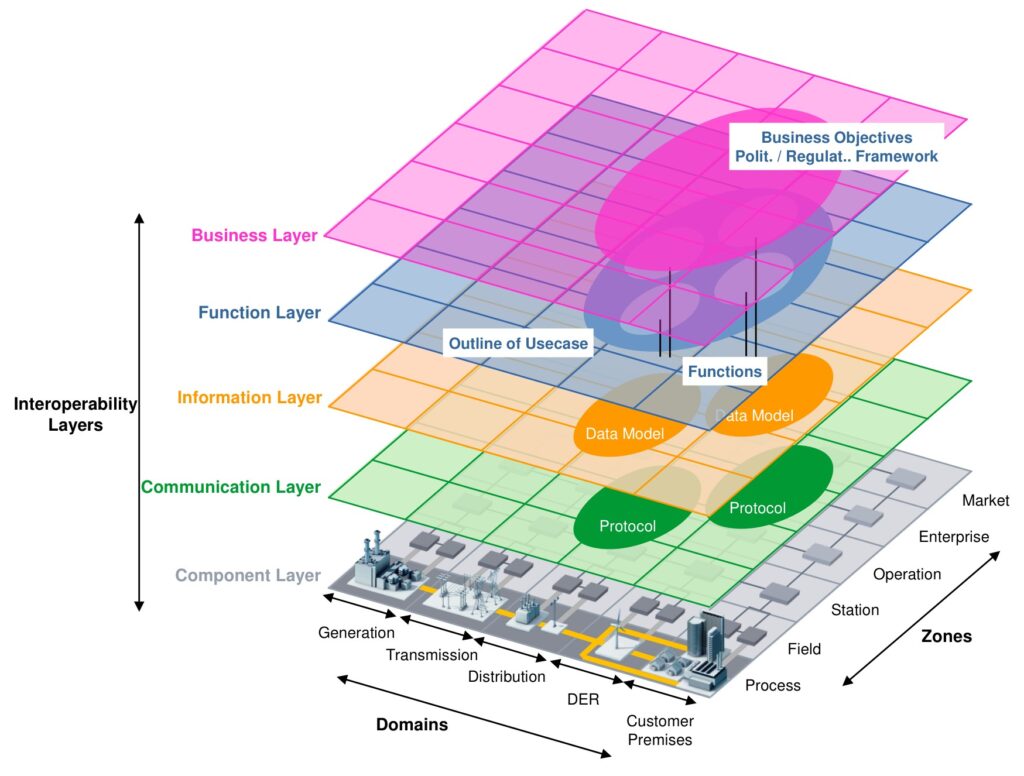
The course begins with an overview of conventional and modern energy systems, including power grids, their components, and architectural principles. Students are introduced to the digitization of energy infrastructures, including the Smart Grid Architecture Model, sector coupling with heating and mobility, and the role of digitalization in the energy transition. Typical use cases such as demand-side management, virtual power plants, and voltage/VAR control are discussed to illustrate both opportunities and challenges.
2. Information and Communication Technology for Smart Grids
This part focuses on the ICT backbone of digital energy systems. Topics include IT/OT convergence, communication protocols, and connectivity technologies such as internet-based communication, power line communication, 4G/5G/6G, IoT technologies, smart meter infrastructures, and blockchain-based approaches. Students gain insight into how reliable communication and data exchange enable intelligent monitoring and control in modern energy networks.
3. Markets and Policy of Energy Systems
Beyond technical aspects, digital energy systems operate within market and regulatory frameworks. This section introduces energy markets in Germany, Europe, and international contexts, and discusses governance, regulation, and emerging business models. Students explore how policy and market design influence the deployment of digital technologies and shape the future of energy systems.
4. Modeling, Analysis, and Design for Energy Systems
Students learn how to model and analyze energy systems using quantitative methods. Topics include time series of generation and demand, power flow analysis, simulation methods, and optimization approaches for planning and operation. This section emphasizes the use of computational tools to understand system behavior and support decision-making in increasingly complex and dynamic energy environments.
5. Control and Artificial Intelligence for Energy Systems
A major focus of the course is the use of advanced control and AI methods in energy applications. Students are introduced to forecasting methods, surrogate models, decision intelligence, and different control paradigms including rule-based control, model predictive control, and AI-based control. The section highlights how intelligent methods can improve efficiency, flexibility, and reliability in operation.
6. Cybersecurity and Privacy for Energy Systems
As energy systems become more connected, security and privacy become critical concerns. This part covers common weaknesses and threat scenarios, privacy regulations and frameworks, load monitoring, intrusion detection and prevention systems, and both rule-based and large-language-model-based approaches for cybersecurity. Students learn to assess risks and understand the importance of secure and privacy-preserving system design.